Easel 19 - Spring 2008
 Editorial
Here is another useful issue of The Easel, I hope. There is a great deal for all of us to do again as we complete the works we expect to show during the Spring and Autumn. Then, again, there is the article you are going to write for the Summer issue of this newsletter and the pics of the work you want displayed on the cover. One may find a home on the front and earn you a voucher to be used at Art for All in Bromley. This time, Dennis wins the voucher.Jill makes a wicked suggestion (interpret ‘wicked’ as you will), and Ann’s AGM Report makes worthwhile reading, if you missed the AGM. There is so much going on and Bernard Victor gives wonderful advice. Whatever you do, do not miss the French and Russian Master Paintings from Moscow and St Petersburg on show at the Royal Academy until 18 April. Tickets are available at the door from 10 am. Adults £11, Concessions £9 (seniors, disabled, NADFAS etc), Students £7.50 Corporate Guests £7.50, Income support, unwaged £4, Children 12-18 years old £4, Children 8-11, £3, Under 7 years old free
From Your Chairman
A Happy New Year to you all. I hope that you have had a wonderful time with your families over Christmas. We are so lucky having the London galleries so near — especially as most of us have to pay nothing to travel to see them. How about making a New Year resolution to see at least one exhibition a month during 2008? If the crowded blockbuster shows in London do not appeal you could hardly do better than making for the Mall Gallery to keep abreast of what the best of our contemporaries are doing. Closer to hand is the 200 world-class paintings at the Queen’s House, Greenwich. It is part of the Maritime Museum’s permanent collection and will be on show continuously for the foreseeable future. Entrance is free and it is well worth a visit. It is not all “maritime”. So much for my general hopes for the future; I will now review our activities of the recent past.
November 2nd – The “4 Corners” Evening: Perhaps members did not quite understand what “Four Corners” meant when they saw it in the programme as we had no more than two dozen people attending. During the evening there was one person in each corner of the room demonstrating or talking about a particular subject:
Ann Holdway was demonstrating her approach to mosaic and at least one member tried her hand at it.
Gilly Hewstone showed her skill at drawing portraits using pencil shading and brought many examples of her work.
Allan Davies gave advice on and showed very clear drawings explaining the principles of perspective.
I was drawing a pastel portrait and brought a number of unframed portraits and photographs of previous commissions.It proved to be an enjoyable evening — members sat for a while at one demonstration before moving round to the next — it was informative and pleasantly social. We must do it again and next time give you more advanced details on who will be doing what.
Private View at St George’s Church, Beckenham: I was very disappointed about the very small number of people attending the Private View. Not only were there very few members but there was little evidence that many had invited friends, neighbours and family to come. Ann sends out invitations to previous buyers but we expect members to invite visitors, too. Without them few pictures will be sold. Remember that the committee works hard to put on these shows and a Private View adds significant costs for the Society.
The Art Auction November 3rd: This event was not well attended either but proved quite enjoyable and those who were there picked up some real bargains. It was held in the Scout hut in Tiepigs lane. Many thanks to Ann and Peter for organising the event and to the committee for their energetic support — including Christine and her friend for the splendid refreshments. A repeat is expected — you will be informed of details when known. Here’s hoping that 2008 will bring continued success to the Bromley Art Society.
Bromley Art Society's Website
The BAS website was launched in time for the New Year. The aims of the website are to provide better information to existing members and to attract new members to the society. The website and meetings are supported by a newsletter to give you up-to-date information in a brief email. This is not intended to replace The Easel in all its glossy glory.
We want to build something of a community around the website, to support the society's activities. It takes time and effort to build this - Please join us in doing so. Feel free to tell us what features you would like to see on the website, in the email newsletter, in The Easel or in the society's meetings.
Perhaps you would like to submit an article, either for The Easel or for the website? Tell us which exhibitions you have visited and what you liked or disliked, or write a review of an art book you have read recently. We hope to have a gallery for members' work soon.
Tou can email me using the contact form on the site. You can also email this magazine. You can add comments in the forums too and I look forward to seeing them.
Adrian Fowle
Webmaster, Bromley Art Socoiety
I Sold A Painting!
I don’t believe it. Not me. Are you sure? Really? (Grin appears) Which one? Really? Me? You must be mixing up me with someone else. No? Which one? (Grin widens) That one! Gosh! (Strange sensation moves up through body into my head) (Smiling faces looking up at me. Yes, you! Yes!) (Grin now permanent) (Speechless).
I have sold a picture at an exhibition. For the first time. All those exhibitions - and nothing! Other people sold pictures, but not me. Never. Nobody wanted one of my pictures on their wall. Other painters sold strange impressionist swirls of garish paint that I couldn’t understand. But nobody wanted my pictures. Real pictures of boats, scenes, happy people at cafés, at the seaside. Now I was a real painter!
Actually, I had “sold” a picture before. About three years ago, in my art class, I had just finished a watercolour of a boat drawn up on a sun baked beach, white buildings in the background, people playing on the sand in the distance. I rarely do watercolour. I just do them when I get the urge to dash off something quick. A lady’s voice said “I’d like to buy that picture. I’d like it for my house.” “How much do you want for it?” Confusion. Speechless. “I – I don’t know.” “I’ve no idea.” “You can have it.” “No, I must give you something.” Stuttered conversation followed. “I’ll give you a bottle of wine for it then,” she said. “Done!” I said.
The next week I received two bottles of good red wine. The glow I felt was unbelievable. Somebody wanted my painting! The embers of that glow remain within me to this day. I think it will stay with me for ever.
Don’t give up, if you have not sold a painting yet. Keep exhibiting, and at as many different places as you can find. Don’t forget that hospitals and the smaller libraries often display amateur work. Look outside your immediate area. Sooner or later you could be lucky!
Ken Brazier
Sergei Bongart 1918 - 1985
20th Century Russian painter Sergei Bongart was born in Kiev in the Ukraine. He studied art in Kiev, Prague, Vienna and Munich, before emigrating to the USA in 1948. From Memphis, Tennessee. He moved to Los Angeles in 1954 where he founded an art school and taught a number of aspiring young painters who later became well-known, nationally collected American artists.Bongart established an art school in Idaho in 1969. He lived half the year in Santa Monica, California and the other half in Idaho. Much of his art reflects the rustic settings which reminded him of his homeland.
Bongart is admired for his richly colored and emotionally expressive landscapes, still lifes and portraits. He was best known as a colorist, working in exaggerated color, using dynamic but carefully controlled color relationships and extolling the virtues of approaching painting as “color first, subject last" Source: Wikipedia
“There are no bad subjects, only lousy artists.
Everything can be forgiven in art, but boring art.”
Sergei Bongart
Painting the Grotesque
I recently embarked on a portrait of Peter Tobin, multi-murder suspect, which raised a few comments in the Wednesday afternoon group viz ‘I couldn’t paint a face like that.’ ‘I would feel uncomfortable living with his eyes following me around.’ ‘Whatever made you want to paint such a subject?’ To which I replied,‘How often do we get the chance to paint evil? (allegedly)’.*
I’m not averse to painting pussy cats and fluffy bunnies but what a dull life it would be if we lived on chocolate cake and honey. Wouldn’t we crave a misshapen jacket potato or a juicy steak?
Tobin presented a challenging subject with his wild eyes, unkempt hair, his contorted features and look of utter defiance. I realised that it would make the portrait even more indigestible if I made him gaze directly at the viewer. I hope I have achieved my aim of capturing (alleged) wickedness. That this grotesque face should be the last thing (allegedly) that those poor girls saw is truly chilling.
So why not depict ugliness or the extraordinary? Leonardo da Vinci did. I understand that he wandered the streets sketching such unfortunates. If it’s good enough for da Vinci, it’s good enough for us! So, members of BAS, why don’t we get out our mirrors and start a self-portrait? How grotesque is that?
* To ensure that I don’t find myself in the next cell to our friend Mr. Tobin I have included a liberal sprinkling of ‘allegedlies’.
Jill Reardon
P.S. On the same subject, the following little gem was found in a Christmas cracker:-
Q. What are measles?
A. What artists paint self-portraits on.
The Strand Studio Club: Life Painting and Drawing
All are welcome to join this friendly and informal life painting group held every Wednesday during term times between 1 and 3 pm. These untutored sessions are angled toward life painting with a single pose running over
2 to 4 weeks.
£40.00 per term (including model fee), £5.00 per session, 10 sessions per term starting on the 9th January 2008. Time: 1 to 3 pm.
The location: Room 18 (Art Room), Second Floor, The Thomas Calton Centre, Alpha Street off Choumert Road, Peckham SE15 4NX
For further information contact Cliff on 07860 796595 or Reg on 020 8670 8016
A Brief Biography of Peter Dinsmore
I do not have an artistic background. As an evacuee, ending up in Cheshire. When my mother remarried, I was brought up on a farm in Gawsworth. I eventually became a chemist in R & D, working in I.C.I. on water/detergent analysis, briefly with Penicillin manufacture and finally in Dyestuff research. I came back to London, worked in paint research and spent many years in developing building additives and acting as a trouble shooter in the Civil Engineering and building industries. This latter involved a lot of travel away from home.
Eventually, tiring of all this, I changed direction and became a teacher until I retired in 1995.
My hobbies were archeology (where I first met my wife Dallas) and gardening (I ended up as secretary of the Croydon and District Allotments and Garden Societies - 4,600 allotments).
In Bromley the scout movement, C.N.D. and the Green Party took up much time and together with Technical Administration I became overworked and headed towards a breakdown.
My doctor advised me to cut down and take up an interest away from work. He suggested Art as an interest. Being a Jack of all trades I gave it a go, joined the W.W.A.A. and loved it, even realising I was a pretty awful artist.
To raise funds for the Green Party I ran a Craft Market. In an effort to fill stalls I put some of my daubs on one and actually sold 4 pictures - unbelievable!. So I ran craft markets for some years, mainly in my school. Each time I booked a stall for myself and did fairly well.
Since I retired I’ve continued to volunteer - a fault in my life I think - but I can’t seem to help it. I work with OXFAM and other charities, one Scout group and two art societies, one of them the B.A.S.
Some years ago I started making my own frames and somehow this has expanded into making and renovating frames for others as well.
I try to balance my lifestyle with my ill health. Full time interests keep me going and I can hopefully postpone most of the ill health for a while yet. However, the admin. of hiring screens and help with exhibitions for the B.A.S. needs to be taken over by a younger, fitter interested party well before I finally retire. I could then maybe just paint and try and match some of the quality of many of my fellow members of B.A.S.
Peter Dinsmore
One of Our members is Missing!
Another year comes to a close and, despite my best efforts, painting and teaching commitments have kept
me away from many monthly meetings at Bromley. Having taken the final step to become a full-time professional artist some 18 months ago now, art has completely taken over my life.
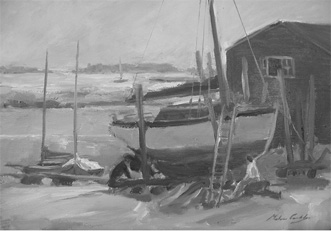
This year saw me take on the role of Hon Secretary at the Maritime Art Group (a group of mainly professional artists, all Lay Members of the RSMA). Meeting twice each month to paint on location has helped everyone develop their outdoor painting skills – especially how to keep out of the rain and be first at the pub! Results can be seen this year at one of two exhibitions, at Cranleigh Art Centre and the Oxmarket Gallery, Chichester.
Back in September, eight artists joined me for a week-long painting break to Sorrento and the wonderfully scenic Amalfi Coast. Whilst the main town of Sorrento is a sophisticated Italian resort, our base was the Hotel Admiral on the waterfront of the “Marina Grande” an artist’s delight with traditional boats moored
along the waterfront and fishermen mending nets in the evening light. During the week there was plenty of time to sketch and paint around the Harbour as well as enjoy trips along the Amalfi Coast to Positano and Ravello plus a full day sketching on the beautiful (if popular) Isle of Capri. With such a small group,
everyone enjoyed as much group and one-to-one tuition as they wished. One intrepid student even joined me at 6.00am one morning to paint the sunrise over the Bay of Naples! Having enjoyed hosting my first painting tour to Italy, next year’s trip will be to Tuscany and Umbria, to explore Siena and the surrounding countryside and vineyards.
Given all these distractions, it is perhaps not surprising I have not been seen around Bromley during the past year. With the possible change of meeting day, and the
launch of an email newsletter, I am hoping to catch up with friends old and new during 2008.
Full details of all Melanie’s activities can be found on her website.
Douzens revisited
Some of you may remember that I wrote about my time spent in the South of France and having been invited to exhibit in the local Art Exhibition. Well, I can report that once again I exhibited in early June.
Because my pieces are all local, the villagers, although not rushing to buy, are clearly delighted to see that I am recording their area. In the artist’s eyes worn and shabby can be seen as beautiful and I am aware that things are changing, being renovated and refurbished. I am recording things as they have been but change can be seen.
Buildings used for the wine trade are gradually being taken over as their use changes.The Butcher’s shop was due to close in early summer. I painted it with its 1960s shop window implanted on a very ancient building. Surprisingly this painting sold and also many of my cards, which some people are beginning to collect.
Two of my paintings were bought by Canadians who are renovating what was known as ’La maison de Termites’. Termites can be a serious problem in this area. Later in September some friends called on the way to Carcasson. There the new proprietor in the ‘Marche Brittanique’, a shop aimed at tourists and Brits. who live in the area, told them that she would be interested to meet me and see my work. I went to see her amidst a cloud burst, the first rain for two months, and a very crowded town with claxons sounding out, etc. - the taxi drivers and pompiers were on strike. I parked by the Canal du Midi and in a few minutes was in the shop. There, Ann the proprietor, immediately bought all the cards I had with me and a few days later came to see my paintings in Douzens. She was very enthusiastic and took nine paintings to have as a display for the Christmas period.
After she left I felt quite bereft and my high white walls were very bare. So, what now? I’m realistic. When I return this year it would be reassuring to have sold at least one but at least they are there for the public to enjoy, I must now work hard scanning and printing my art work for more cards. I forgot to say that a local gite also sells my cards. Perhaps you are interested to know if I work plein air. Yes, I prefer to go on my bike, also I use my digital camera, which is such a boon. As I paint, people open their windows and greet me. This Autumn the streets had the rich smell of fruity wine because it was the the season of the vendage (grape harvest). The countryside yielded tasty snacks of grapes missed by the machines, almonds and walnuts, although the figs were finished. I made my fig jam in early August.
The textured buildings with red shutters often huddled together continue to inspire me. Walking, cycling, motoring, all is a joy in this unspoilt area. I’m only sorry I missed the glorious colours of the vines as they turn to all colours including deep crimson. Each vineyard and vine has a different colour. The area that I refer to is Aude, South of Carcasson.
Another piece of cultural news, I’ve joined the choir!
Christine Mallion
Paper for Watercolour - Part 2
Don’t waste your money buying cheap paper of poor quality, spend it on the very best. Three of the very best are Bockingford, Saunders Waterford and, my personal favourite, Arches Aquarelle. Here is the SECOND of three items on these papers to encourage members to consider their use. I believe that they are the more economical in the long run. (Ed.)
SAUNDERS WATERFORD SERIES FINEST
NATURAL WHITE WATER-COLOUR PAPER
Saunders Waterford is surely not only one of the highest-grade water colour papers available but also one of the most versatile, being suitable for all techniques. The Saunders Waterford series is made on cylinder mould machines. This production process gives the paper stability for good flatness; the wool felt fibres and the fine surface markings round off the product to giveit its unique character and beautiful look. Saunders Waterford is made from 100% long-fibre cotton (rag) and is not only acid free but also additionally buffered with calcium carbonate. These characteristics ensure that the best archival permanence is attained and give long-term protection against environ-mental effects. The product is gelatine tub sized and also internally sized to give greater strength, in accordance with long-established tradition. The
Saunders Waterford series offers the best characteristics of a ‘strong’ paper: it is resistant to fibre lift when removing masking materials; lines will not feather when pen and ink are used, and even erasure leaves almost no trace. The paper can withstand multiple erasures when using pencil or char-coal. The special sizing process creates a particularly receptive surface for multiple watercolour washes as colour can be taken off with water and a new wash applied quite evenly. The sheets have four deckled edges. The lower left corner bears a quality stamp mark and the lower right corner bears the watermark ‘Saunders Waterford’. Saunders Waterford carries the Royal Water Colour Society seal of approval.
The above is from the on-line catalogue of greatArt (edited)
Secretary's Report 2007
Exhibitions: We had an excellent response from members for our Spring exhibition
with sales holding their own. The preview for The Open at St. George’s Church was
poorly attended; sales were moderate and our conclusion was that it was too late in
the year for this venue so hopefully this year’s venue will be in September. Poor
weather hit all our open air exhibitions so they were really a wash out in 2007 - it is
something we just have to take a chance with. The Preview at Ripley Art Centre was
attended by mainly the artist themselves and continues to be a venue that just does
not attract enough of the public.
For 2008 we are looking at other venues some of which are more suitable for a
small number of members to show at rather than the whole of the society. Details
will be printed in the Easel, if you are interested but don’t know where to start,
please contact me.
The Easel continues to inform and delight us through the efforts of our editor Allan.
We lost Joseph to the sunny shores of Corsica earlier in the year and are about
to lose Malcolm Tait, our stalwart membership secretary, who also plans to be
travelling more in the future.
Christine has agreed to take on responsibility for Press and Publicity.
John Taphouse has been taking care of the exhibition finances.
Brenda Sayburn has been nominated as our next membership secretary.
Jill Reardon, although not a member of the actual committee, is now responsible
for monthly meeetings at Verrall Halls.
Derrick continues to design and produce our posters
Peter is still looking for an exhibition assistant and we have a vacancy for the Vice
Chair.
Don manages our finances and keeps us all in check. He managed to obtain a
small grant from the Bromley Arts Council which is earmarked for new velcro hooks.
We do owe Malcolm a great depth of gratitude not only for his work as membership
secretary but also for all the support and effort he puts in at exhibitions, not only
with installing the display boards, serving the wine, but also for covering unpopular
stewarding time plus extra slots when needed. Fortunately for us he is happy to
still, for now, help out with refreshments at the monthly meetings. His presence as
part of the committee will be greatly missed.
Ann Holdway
Viewing Fine Art
Most of you probably visit the major London Galleries for their blockbuster exhibitions and some of you are probably regular visitors to the Mall Gallery for its excellent exhibitions of work from its associated bodies, but did you know that there are ways of seeing major works of art that are not normally on view .
The first way is to visit the three major auction houses in London, all of whom have regular art auctions. The works which are to be sold are normally on view for the week before the auction and you do not have to be a potential bidder to go and view them. Christie’s in South Kensington, seem to have a virtually continuous program of art auctions. They are generally themed so you will have maritime art or animal art, paintings from a particular period or poster art. Probably works not by the most famous artist but all of a very high standard. Bonhams in New Bond Street have similar auctions but not so often and generally of higher quality, but the pinnacle of art auctions are held at Sotheby’s in New Bond Street. In early February they had an Impressionist and Modern sale which included works by most of the major impressionist and modern artists such as Renoir , as well as works by other impressionists and modern painters who might be called second string like Cailebotte and Boudin. These are paintings that you will probably never get a chance to see again, as they will end up in the collections of very wealthy patrons or institutions. There are no restrictions just walk in and look around. Catalogues are there to be seen and used. You might be tempted to buy one. They are expensive but good value. Christie’s have similar high end sales at their gallery in St. James’.
The other way is to visit the many dealers’ galleries. They look rather formidable but in my experience they do not mind non customers looking round. You might have to ring a door bell to get entry , but once inside they will not worry you after asking if they can be of help. Bond Street is again a good area to visit. Richard Green opposite Sotheby’s always has a good selection of British art and usually some Impressionist gems. Next door the Fine Art Centre also specialises in British art of the 19th and 20th century. Cork Street just around the corner is full of galleries. The Waddington Gallery specialises in more Modern British art. They had a super exhibition of Patrick Caulfield late last year. Opposite is Browse & Darby who include Euan Uglow and Elisabeth Blackadder amongst their artists.
Other galleries cater for all tastes from traditional to Britart. If works on paper are your thing, I’d recommend a visit to Chris Beetles in Ryder Street, St.James. The works of most of the best of British illustrators are on view there and some are even quite reasonably priced.
Finally a non-dealer gallery, which does not seem so well known. The Fleming Collection in Grosvenor Street only shows works by Scottish painters, but I have seen some stunning paintings there and have got familiar with the works of some great painters like McTaggart, Redpath and the Scottish Colourists. Entry
is free and welcoming. There are many other galleries all around London, with Hoxton being full of them, but I must admit I am not familiar with them so cannot make recommendations. Next time you have some spare time visit some of these places and I think you will be amazed at the variety of art available to see for nothing.
Bernard Victor
Budds in Kent
Last year I had the privilege and pleasure of spending a weekend with Oliver Budd, renowned, mosaic artist, along with some fellow mosaicists. It is something really special to have the artist himself explain the thoughts behind each work of art and Oliver was extremely generous with his time and with sharing his expertise and techniques and answering the many questions put to him. We also spent time in his studio where he has rolls of designs dating back to the 60’s, which are of his father’s work,whose foot-steps he has followed.
There are many modern mosaics, both public and private, which the majority of the population will not be aware of. Unfortunately, we don’t appear to place the same value on them as ancient ones because some of Kenneth Budds (Oliver's father) have already been destroy to make way for new buildings or buried.
Well, on your one of your days out, you might like to take a small detour to take a look at one of Oliver’s mosaics and it will be well worth it. Most of Oliver's mosaics depict social history and, apart from the initial story that is spelled out, you need to keep looking and you will spot a butterfly here or an owl in a tree there. Just keep looking. The mosaics are full of colour and life.
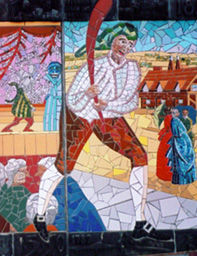 Otford, Kent, where Oliver was commission to produce a mosaic for the millennium, eight panels on the village hall show Otford and the surrounding district from prehis- toric times to the year 2000 AD. Facing onto the road it is easy to find right next door to the public car park right. Laid on mental panels, which makes it easy to remove if necessary and for restoration, an invention of Kenneth's. Note how Oliver cleverly links the scenes by continuing the picture into the next panel or a leg crossing over so the eye reads the scene as a whole rather than a set of panels.
The panels are framed with black-leaded castings which continue the history and comment on the images depicted. One favourite are the nightingales above and below Thomas a Becket. They are singing above him. Apparently, however, their song disturbed him so he had them killed which is why they lie on their backs below him. If you look closely in the surround of the last panel you will see DNA, a mobile phone and the hand print of the eldest and the youngest person in the village in the year 2000 AD. The Romano- British villa at nearby Lullingstone, which has some interesting mosaics, is also shown.
At the nearby roundabout look out for the sign to the village showing the church and the Bishop’s Palace. It was made by one of Oliver’s pupils, Angela Derby.
Ann Holdway
The figure shows detail from Olvier's work.