Budds in Kent
Last year I had the privilege and pleasure of spending a weekend with Oliver Budd, renowned, mosaic artist, along with some fellow mosaicists. It is something really special to have the artist himself explain the thoughts behind each work of art and Oliver was extremely generous with his time and with sharing his expertise and techniques and answering the many questions put to him. We also spent time in his studio where he has rolls of designs dating back to the 60’s, which are of his father’s work,whose foot-steps he has followed.
There are many modern mosaics, both public and private, which the majority of the population will not be aware of. Unfortunately, we don’t appear to place the same value on them as ancient ones because some of Kenneth Budds (Oliver's father) have already been destroy to make way for new buildings or buried.
Well, on your one of your days out, you might like to take a small detour to take a look at one of Oliver’s mosaics and it will be well worth it. Most of Oliver's mosaics depict social history and, apart from the initial story that is spelled out, you need to keep looking and you will spot a butterfly here or an owl in a tree there. Just keep looking. The mosaics are full of colour and life.
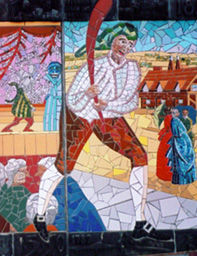 Otford, Kent, where Oliver was commission to produce a mosaic for the millennium, eight panels on the village hall show Otford and the surrounding district from prehis- toric times to the year 2000 AD. Facing onto the road it is easy to find right next door to the public car park right. Laid on mental panels, which makes it easy to remove if necessary and for restoration, an invention of Kenneth's. Note how Oliver cleverly links the scenes by continuing the picture into the next panel or a leg crossing over so the eye reads the scene as a whole rather than a set of panels.
The panels are framed with black-leaded castings which continue the history and comment on the images depicted. One favourite are the nightingales above and below Thomas a Becket. They are singing above him. Apparently, however, their song disturbed him so he had them killed which is why they lie on their backs below him. If you look closely in the surround of the last panel you will see DNA, a mobile phone and the hand print of the eldest and the youngest person in the village in the year 2000 AD. The Romano- British villa at nearby Lullingstone, which has some interesting mosaics, is also shown.
At the nearby roundabout look out for the sign to the village showing the church and the Bishop’s Palace. It was made by one of Oliver’s pupils, Angela Derby.
Ann Holdway
The figure shows detail from Olvier's work.