
is being built at www.bromleyartsociety.org.uk
Until it is ready, this previous website is being maintained at www.bromleyartsoc.org.uk. Please be patient with us.
Is there no limit to what science can reveal to us? In yet another leap forward, this week a French inventor, Pascal Cotte, established after numerous tests that the Mona Lisa originally did have eyelashes and eyebrows. Dan ‘Da Vinci Code’ Brown must be kicking himself for missing that secret!
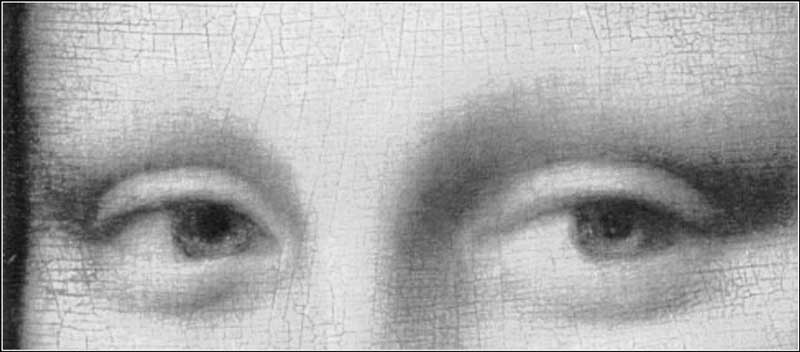
In 2003, Professor Margaret Livingstone of Harvard University suggested after extensive study that ‘the elusive quality of the Mona Lisa’s smile can be explained by the fact that her smile is almost entirely in low spatial frequencies, and so is seen best by your peripheral vision.’ In 2005, another scientific study deciphered that smile using emotion-recognition software and concluded that the Mona Lisa was ‘mainly
happy’. Last year, a forensic scientist called Matsumi Suzuki was even able to use voice-simulation programmes to ‘reproduce’ la Gioconda’s voice.
What is it that drives scientists back to re-examine a work of art with more and more elaborate techniques? While most of us just want to stand and appreciate a painting, scientists, it seems, would rather ‘discover’ something about it – prove that what we see is not what was originally created, or scrutinise, dissect and explain our reaction to it.
People of a scientific bent have a different way of encountering the world. Recently, I visited Tate Modern in the company of an economist. Not a fan of the art on display, he took the opportunity instead to time how long people spent looking at each painting (3.5 seconds on average) and reading the accompanying notes (likewise, 3.5 secs.). A total of seven seconds to take in a piece of great art, its composition, development and importance, before moving on. Would it ever have occurred to you to conduct such an experiment?
Perhaps, like me, you hadn’t noticed that the Mona Lisa today has no facial hair. Nevertheless, an important part of our Christian discipleship lies in developing a playful inquisitiveness that encourages us to look closer at the world and ask the question, ‘What is missing from this picture that may be revealed?’ So that, as G K Chesterton suggested, we can ‘contrive to be at once astonished at the world and yet at home in it’.